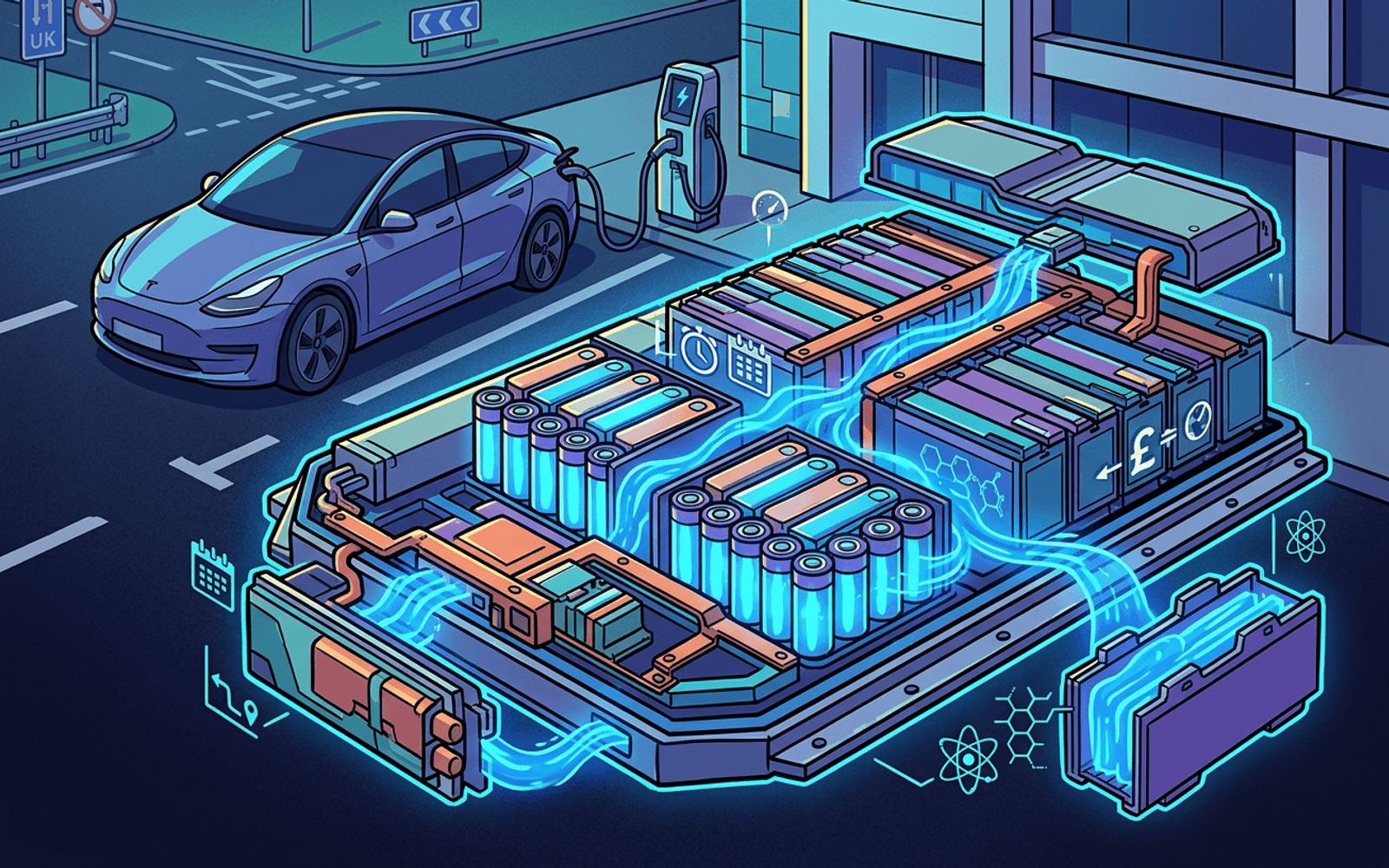
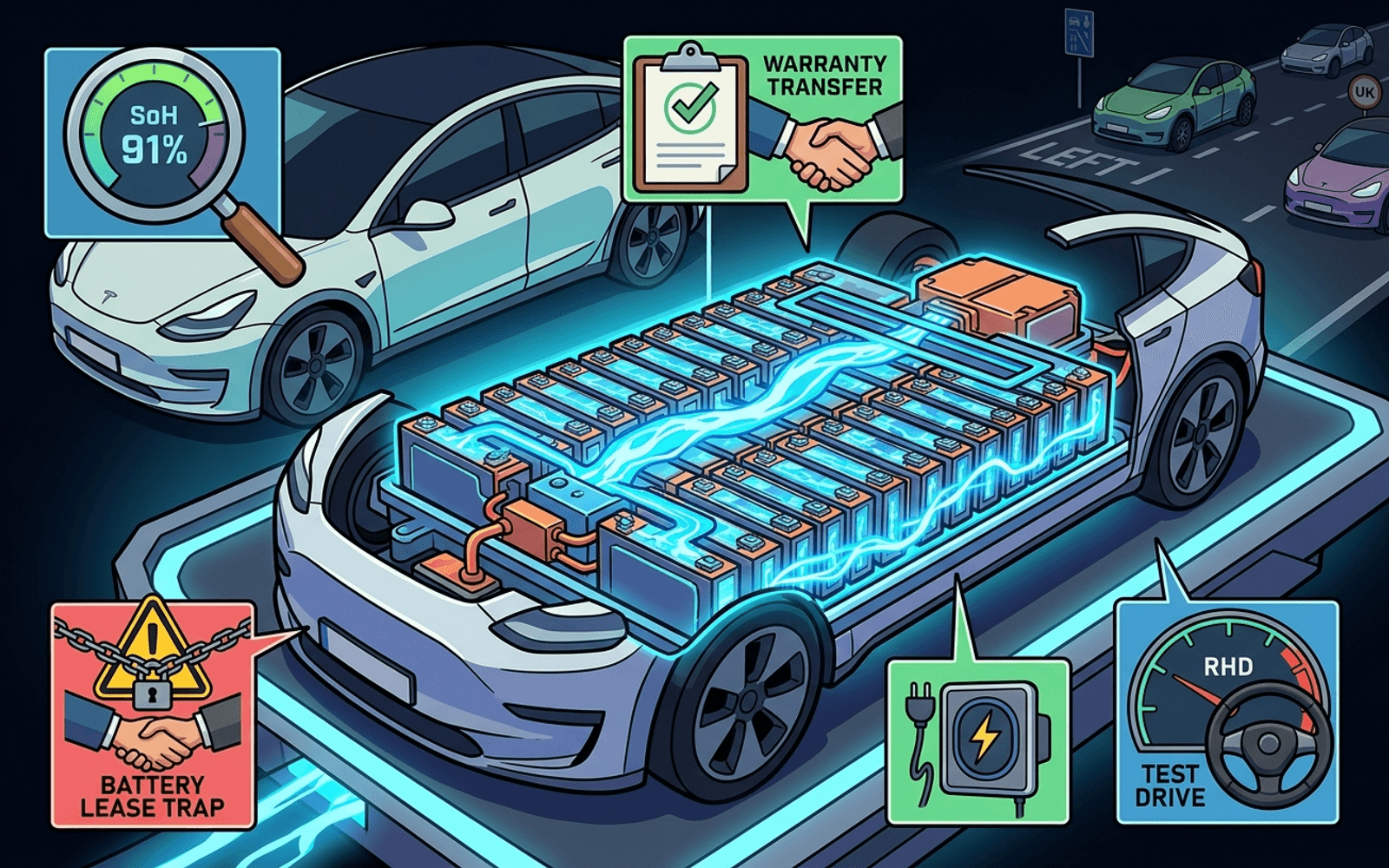
The battery is an electric car’s most expensive component - usually 30-50% of the total price. That makes battery capacity per pound one of the most revealing measures of value when you compare different cars. A car offering 2 kWh per £1,000 provides twice the energy storage of one offering 1 kWh per £1,000.
We've worked out battery value metrics for every EV in the UK: kWh per £1,000, cost per kWh, miles per kWh, and warranted kWh-years per pound - a measure that brings battery size and warranty length together in one value figure.
Most battery per pound
These EVs provide the most kWh of battery capacity per £1,000 of list price. A higher figure is better - more energy storage for less money:
| # | Car | kWh/£1k | Battery | Price | £/kWh | Chemistry |
|---|---|---|---|---|---|---|
| 1 | Renault Scenic | 2.41 | 89kWh | £36,995 | £416 | NMC |
| 2 | Citroën ë-C5 Aircross | 2.35 | 79.9kWh | £34,065 | £426 | NMC |
| 3 | Leapmotor T03 | 2.33 | 37.3kWh | £15,995 | £429 | LFP |
| 4 | GWM ORA ORA 03 | 2.26 | 48kWh | £21,245 | £443 | LFP |
| 5 | Jaecoo E5 | 2.22 | 61kWh | £27,505 | £451 | LFP |
| 6 | Kia EV2 | 2.18 | 61kWh | £27,995 | £459 | NMC |
| 7 | VW ID.5 | 2.14 | 79kWh | £36,995 | £468 | NMC |
| 8 | VW ID.4 | 2.14 | 79kWh | £36,995 | £468 | NMC |
| 9 | Leapmotor B10 | 2.13 | 67.1kWh | £31,495 | £469 | LFP |
| 10 | MG4 EV | 2.13 | 64kWh | £29,995 | £469 | LFP |
Most miles per kWh - battery efficiency
Compare battery capacity with efficiency when choosing an electric car. The figures below show the listed distance per unit of battery capacity:
| # | Car | Mi/kWh | Range | Battery | Wh/km | Body |
|---|---|---|---|---|---|---|
| 1 | Estrima Birò | 14.78 | 34 mi | 2.3kWh | - | Quadricycle |
| 2 | Micro Microlino | 10.48 | 110 mi | 10.5kWh | - | Quadricycle |
| 3 | Silence S04 | 8.93 | 50 mi | 5.6kWh | - | Quadricycle |
| 4 | Fiat Topolino | 8.7 | 47 mi | 5.4kWh | 73 | Quadricycle |
| 5 | Citroën Ami | 8.55 | 47 mi | 5.5kWh | 71 | Quadricycle |
| 6 | Dacia Spring | 5.79 | 139 mi | 24kWh | 124 | Hatchback |
| 7 | Mercedes-Benz CLA | 5.69 | 484 mi | 85kWh | - | Saloon |
| 8 | Tesla Model 3 | 5.53 | 332 mi | 60kWh | 130 | Saloon |
| 9 | Ford Puma Gen-E | 5.53 | 259 mi | 46.8kWh | 130 | SUV |
| 10 | Mercedes-Benz CLA Shooting Brake | 5.52 | 469 mi | 85kWh | 130 | Estate |
Cars delivering high miles-per-kWh are generally lighter and more aerodynamic, with efficient powertrains. They also fare better in real-world conditions vs WLTP, as their efficiency advantage compounds at motorway speeds and in cold weather.
Useable battery ratio
You cannot use all the battery - manufacturers reserve a buffer (typically 5-15%) to guard against deep discharge and overcharge. These EVs make the highest percentage of their total battery capacity available to you:
| # | Car | Useable % | Total | Useable | Price |
|---|---|---|---|---|---|
| 1 | Mercedes-Benz GLC | 100% | 94kWh | 94kWh | £61,100 |
| 2 | Renault Scenic | 100% | 89kWh | 89kWh | £36,995 |
| 3 | VW ID.Buzz LWB | 100% | 86kWh | 86kWh | £67,945 |
| 4 | Mercedes-Benz CLA Shooting Brake | 100% | 85kWh | 85kWh | £49,900 |
| 5 | Mercedes-Benz GLB | 100% | 85kWh | 85kWh | £46,100 |
| 6 | BMW iX3 | 100% | 82.6kWh | 82.6kWh | £53,250 |
| 7 | VW ID.5 | 100% | 79kWh | 79kWh | £36,995 |
| 8 | VW ID.Buzz | 100% | 79kWh | 79kWh | £60,005 |
| 9 | VW ID.4 | 100% | 79kWh | 79kWh | £36,995 |
| 10 | VW ID.7 | 100% | 77kWh | 77kWh | £51,035 |
A higher useable ratio makes more of the battery you pay for available to use. However, a bigger buffer can extend battery longevity, creating a trade-off between range today and degradation over the longer term.
Warranted kWh-years per pound
This distinctive metric multiplies battery size by warranty years before dividing by price. It answers: how much guaranteed battery life does each pound buy? A car with 60kWh and an 8-year warranty = 480 kWh-years. Divide by price to reveal the best long-term battery value:
| # | Car | kWh·yr/£1k | Battery | Warranty | Price |
|---|---|---|---|---|---|
| 1 | KGM Torres EVX | 19.8 | 73.4kWh | 10 yrs | £36,995 |
| 2 | Renault Scenic | 19.2 | 89kWh | 8 yrs | £36,995 |
| 3 | Citroën ë-C5 Aircross | 18.8 | 79.9kWh | 8 yrs | £34,065 |
| 4 | Leapmotor T03 | 18.6 | 37.3kWh | 8 yrs | £15,995 |
| 5 | GWM ORA ORA 03 | 18.1 | 48kWh | 8 yrs | £21,245 |
| 6 | Jaecoo E5 | 17.7 | 61kWh | 8 yrs | £27,505 |
| 7 | VW ID.5 | 17.1 | 79kWh | 8 yrs | £36,995 |
| 8 | VW ID.4 | 17.1 | 79kWh | 8 yrs | £36,995 |
| 9 | Leapmotor B10 | 17.1 | 67.1kWh | 8 yrs | £31,495 |
| 10 | MG4 EV | 17.1 | 64kWh | 8 yrs | £29,995 |
Battery cost by chemistry
Battery chemistry affects production costs. LFP (lithium iron phosphate) costs less to produce, which should theoretically deliver more kWh for each pound spent:
- NMC - average £691 per kWh / 1.56 kWh per £1k (103 models)
- LFP - average £746 per kWh / 1.69 kWh per £1k (43 models)
LFP batteries usually cost less per kWh but offer lower energy density (more weight for the same capacity). NMC and NCA cost more but weigh less. Read our battery chemistry guide for the full comparison.
Biggest batteries available
Explore the electric cars with larger listed battery packs below, then compare their range, efficiency and price:
| # | Car | Battery | £/kWh | Range | DC charge | Price |
|---|---|---|---|---|---|---|
| 1 | Mercedes-Benz EQS SUV | 120kWh | £1076 | 366 mi | 200kW | £129,170 |
| 2 | Land Rover Range Rover | 118.5kWh | £1300 | 372 mi | 350kW | £154,070 |
| 3 | Land Rover Range Rover LWB | 118.5kWh | £1820 | 372 mi | 350kW | £215,670 |
| 4 | Mercedes-Benz G-Class Electric | 116kWh | £1335 | 283 mi | 200kW | £154,870 |
| 5 | Porsche Cayenne | 113kWh | £736 | 358 mi | 390kW | £83,200 |
| 6 | Lotus Eletre | 112kWh | £776 | 373 mi | 367kW | £86,885 |
| 7 | Polestar 5 | 112kWh | £799 | 421 mi | 350kW | £89,500 |
| 8 | Hyundai IONIQ 9 | 110.3kWh | £589 | 385 mi | 233kW | £64,995 |
| 9 | Audi e-tron GT | 105kWh | £853 | 385 mi | 320kW | £89,555 |
| 10 | Porsche Taycan Cross Turismo | 105kWh | £945 | 347 mi | 320kW | £99,200 |
What to prioritise
- For daily commuters - efficiency (miles per kWh) counts for more than battery size alone. A small, efficient battery costs less and charges faster
- For long-distance drivers - battery size and charging speed matter most. More kWh means fewer stops, while fast charging means shorter stops
- For budget buyers - kWh per £1k highlights where your money stretches furthest. Chinese brands often lead here
- For long-term ownership - warranted kWh-years per pound brings battery size and warranty length together in a single figure
Battery value is only part of the picture. Read the overall value score guide for a wider comparison, or the warranty maths guide for a closer look at battery warranty terms.
Founder of EVcarsguide. Web technologist and data specialist tracking the UK EV market.