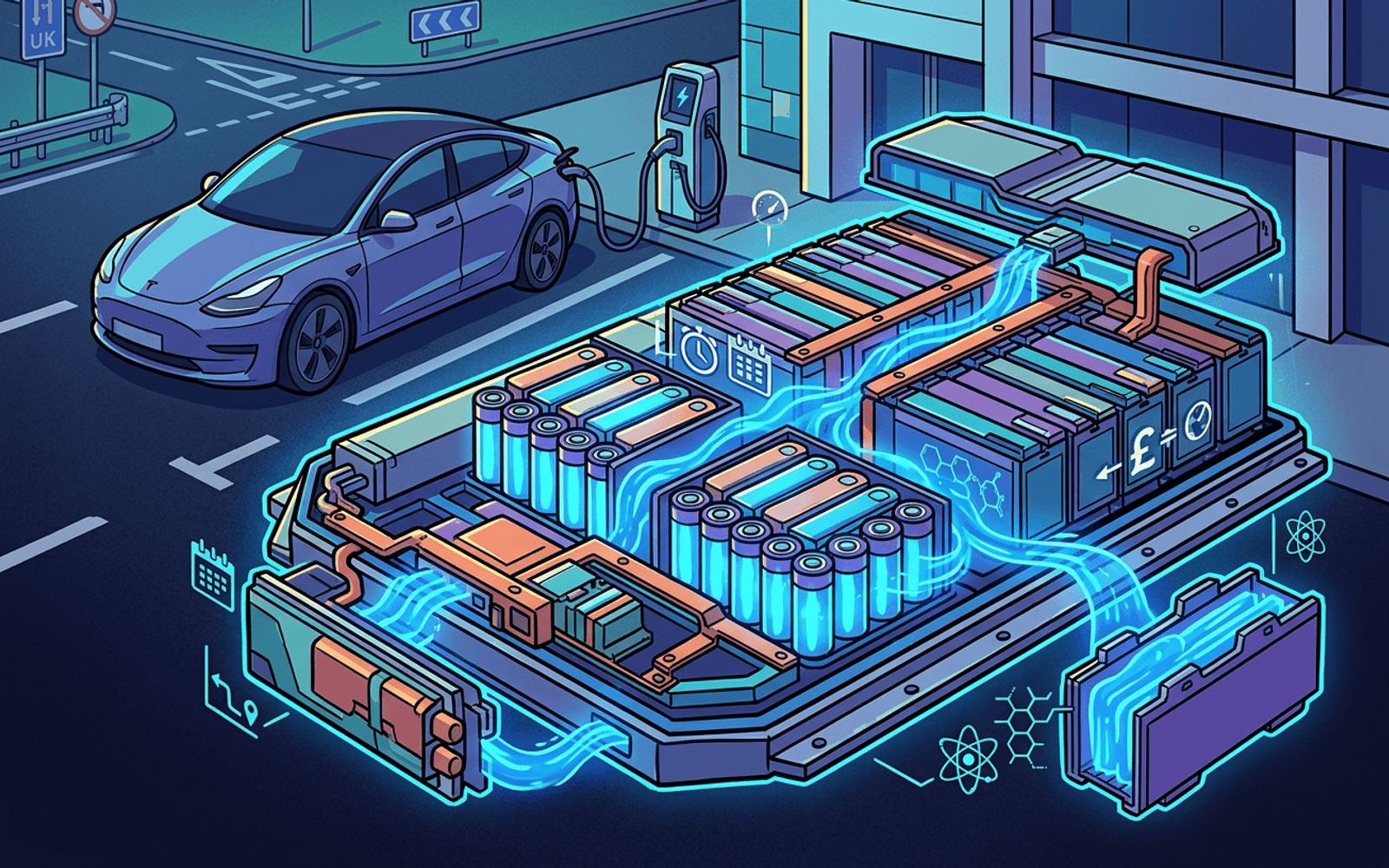
Compare EV battery chemistries alongside the specifications of the car you are considering. This guide explains LFP, NMC and NCA terminology and explores questions about range, charging, longevity, cold-weather use and cost.
The main chemistries
LFP - lithium iron phosphate
LFP batteries replace nickel and cobalt with iron, making them cheaper and more abundant. Once regarded as a "budget" chemistry, they now power cars from Tesla, BYD, MG, and others.
Advantages:
- Longevity - LFP cells can withstand 3,000-5,000 charge cycles vs 1,000-2,000 for NMC. The battery is likely to outlast the car
- Safety - battery chemistry does not remove the need for fire precautions. Lithium-ion EV batteries can catch fire; follow the vehicle manufacturer’s charging and safety instructions.
- Cost - leaving out cobalt and nickel reduces raw material costs. That results in cheaper cars
- Charge to 100% - LFP batteries can be regularly charged to 100% without degradation. Most manufacturers recommend it
Disadvantages:
- Lower energy density - more weight for the same capacity. That means either reduced range or a heavier car
- Cold weather - performance falls further in freezing temperatures. Preconditioning helps considerably
- Voltage curve - the state-of-charge display can be less accurate (a flat voltage curve makes estimating remaining charge harder for the BMS)
NMC - nickel manganese cobalt
NMC is the most widely used chemistry in European and Korean EVs. Variants include NMC 622, NMC 811, NMC 9½½ - these numbers describe the ratio of nickel, manganese, and cobalt. A higher nickel content means greater energy density.
Advantages:
- High energy density - less battery weight for the same range. Better for larger, longer-range cars
- Good all-round performance - balanced charging speed, range, and cold-weather performance
- Proven technology - decades of development and optimisation
Disadvantages:
- Cost - cobalt and nickel are expensive and supply-constrained
- Degradation - avoid regularly charging above 80% for maximum longevity
- Thermal sensitivity - requires more sophisticated thermal management
NCA - nickel cobalt aluminium
Tesla is the main user, sourcing cells from Panasonic, LG, and others. Among the common chemistries, NCA delivers the highest energy density.
- Highest energy density - enables the longest ranges per kg of battery
- Excellent fast-charging performance
- More costly per kWh than LFP, comparable to NMC
- Tesla's newer 4680 cells feature a modified NCA chemistry
Emerging chemistries
- LMFP (lithium manganese iron phosphate) - BYD's next generation. Greater energy density than LFP, with similar cost advantages. Already appearing in the latest models
- Sodium-ion - contains no lithium at all. Very cheap, with lower energy density. BYD is trialling it in budget Chinese models. Could appear in sub-£20k UK cars
- Solid-state - the holy grail. Greater density, faster charging, safer. Toyota and Samsung SDI targeting the late 2020s for volume production
Which EVs use which chemistry?
| # | Car | Battery | Range | DC charge | From |
|---|---|---|---|---|---|
| 1 | BYD Seal | 82.5kWh | 354 mi | 150kW | £46k |
| 2 | Mazda 6e | 78kWh | 348 mi | 195kW | £39k |
| 3 | Polestar 2 | 70kWh | 344 mi | 180kW | £45k |
| 4 | Tesla Model 3 | 60kWh | 332 mi | 175kW | £38k |
| 5 | BYD ATTO 3 | 74.8kWh | 317 mi | 220kW | £39k |
| 6 | Tesla Model Y | - | 314 mi | 175kW | £42k |
| 7 | Renault Megane | 67kWh | 306 mi | 165kW | £32k |
| 8 | MG IM5 | 75kWh | 304 mi | 153kW | £39k |
| 9 | BYD Sealion 7 | 82.5kWh | 300 mi | 150kW | £45k |
| 10 | XPENG G6 | 68.5kWh | 292 mi | 382kW | £40k |
| 11 | Ford Mustang Mach-E | 72.6kWh | 292 mi | 150kW | £51k |
| 12 | Smart #5 | 76kWh | 288 mi | 150kW | £40k |
| 13 | KGM Torres EVX | 73.4kWh | 287 mi | - | £37k |
| 14 | Ford Capri | 58kWh | 286 mi | 105kW | £37k |
| 15 | MG4 EV | 64kWh | 280 mi | 154kW | £30k |
Generally:
- Chinese manufacturers (BYD, MG, GWM Ora) - predominantly LFP
- Korean manufacturers (Hyundai, Kia, Genesis) - NMC
- European manufacturers (BMW, VW, Mercedes) - NMC
- Tesla - LFP in standard-range models (Model 3 RWD, Model Y RWD), NCA in long-range/performance
What does this mean for you?
If you prioritise longevity and value
Choose LFP. These batteries will last longer, cost less, and you can charge to 100% daily without worrying. Ideal if you're buying to keep for 5+ years or if you want the lowest purchase price.
If you prioritise range and weight
Choose NMC or NCA. The higher energy density means more range for the same battery weight, which also means better handling and lower tyre wear. Just keep daily charging to 80%.
For UK winters
NMC and NCA cope slightly better with cold weather out of the box. A heat pump and good preconditioning substantially narrow the gap for LFP cars. If you live in Scotland or northern England, check whether your LFP car has a heat pump - it makes a genuine difference.
Battery chemistry matters, but it is not the only consideration. Use our search and filter tools to compare range, charging speed, and price for every EV available in the UK, or explore the fastest charging EVs available today.
Founder of EVcarsguide. Web technologist and data specialist tracking the UK EV market.