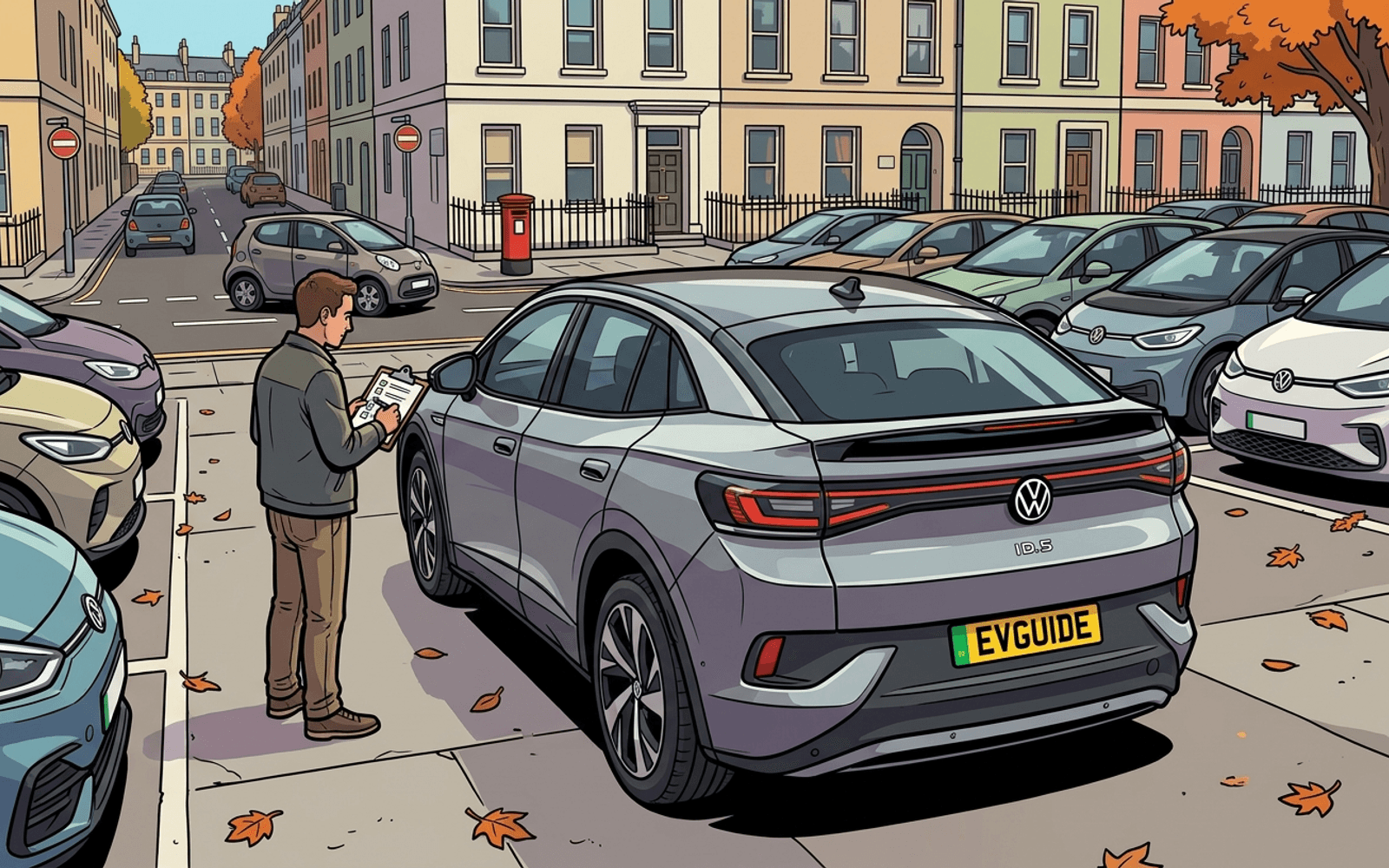
The VW ID.4 is among the UK’s most widely available used electric family SUVs, and one of the least expensive, starting around £13,500 for a 2022 example. This guide explains batteries and motors, whose names changed twice, plus the recall, warranty, owner experiences, likely prices and checks to make. There’s a print-out checklist at the end.
- Cheapest: a 2022–2023 Pure 52 kWh priced around £13,500–£20,000. Suitable for local journeys, though range is a third below the 77 kWh version.
- Best all-rounder: a 2022–2023 Pro 77 kWh priced around £15,500–£25,500. A 2024 Pro with its considerably stronger 286PS motor costs only around £2,500 more than a 2023 car.
- Nearly new: a Pure registered in 2026 with a couple of thousand miles asks around £25,500, against £35,495 for a new grant-assisted example. Check battery capacity: most use the earlier 52 kWh rather than the 2026 version’s 58 kWh.
- Check before you buy: the front-seat bolt recall on cars built August 2022 to April 2024, whether it has the optional heat pump, and that software updates have been done.
Which ID.4 are you looking at?
The ID.4 has kept one body since 2021, although VW has revised the motors and batteries twice. The battery capacity in an advert, 52, 58, 77 or 79 kWh using VW’s usable figure, combines with the name to identify which version you are viewing:
| Version | UK years | Battery | Power | WLTP range | Rapid charging |
|---|---|---|---|---|---|
| Pure / Pure Performance | 2021–2023 | 52 kWh | 125 kW | 222 miles | 110 kW |
| Pro Performance | 2021–2023 | 77 kWh | 150 kW | 323 miles | 135 kW |
| GTX | 2021–2023 | 77 kWh | 220 kW, 4WD | 301 miles | 135 kW |
| Pure | 2024–2026 | 52 kWh | 125 kW | 222 miles | 110 kW |
| Pro (286PS) | 2024–2026 | 77 kWh | 210 kW | 337 miles | 135 kW |
| GTX (340PS) | 2024–2026 | 77 kWh | 250 kW, 4WD | 322 miles | 175 kW |
| New Pure | 2026– | 58 kWh | 140 kW | 268 miles | 105 kW |
| New Pro | 2026– | 79 kWh | 210 kW | 352 miles | 165 kW |
| New Pro 4MOTION | 2026– | 77 kWh | 220 kW, 4WD | 341 miles | 165 kW |
| New GTX Edition | 2026– | 77 kWh | 250 kW, 4WD | 326 miles | 185 kW |
- 2021–2023: “Pro Performance” identifies a 77 kWh battery and 204PS motor; “Pure” and “Pure Performance” use 52 kWh with 148PS or 170PS. Initial 77 kWh examples accepted up to 125 kW charging, with later cars accepting up to 135 kW. Trims included Life, Style, Family and Max, alongside 1ST Edition, City and four-wheel-drive GTX, introduced July 2021.
- The November 2023 upgrade (2024 cars) introduced a new 286PS motor delivering 75% greater torque, increased range and a larger screen. Listings omit “Performance”: a “Pro 77kWh” from 2024 onwards uses the updated motor. GTX output rose to 340PS, with 4MOTION charging increased to 175 kW. Trims moved to Life and Style, followed by Essential, Match and Black Edition.
- The early 2026 upgrade introduced 58 kWh Pure and 79 kWh Pro versions, 165–185 kW charging and vehicle-to-load. Many advertised 2026 registrations are earlier models, so verify listed battery capacity.
Full specs are on the 2021–2023 ID.4 page and the current ID.4 page.
Recalls
- Front seat backrests (2024): VW recalled 634 ID.4s and ID.7s manufactured between 30 August 2022 and 18 April 2024: the bolts connecting the seat backrest and seat base could be incorrect, potentially preventing the seat from holding its occupant properly during a crash. Replacement bolts are fitted.
- A tiny 2021 recall affected two examples built during spring 2021 with a steering-gear component issue.
Check the specific car on GOV.UK’s recall checker and ask for the paperwork.
Warranty: check what’s left
VW provides high-voltage battery warranty cover for 8 years or 100,000 miles, and guarantees it will keep at least 70% of its capacity in that time. The car itself has a 3-year / 60,000-mile warranty:
- Registered 2021: car warranty ended 2024; battery to 2029, or 100,000 miles if sooner.
- Registered 2022: car warranty ended 2025; battery to 2030, or 100,000 miles if sooner.
- Registered 2023: car covered to 2026 (60,000 miles); battery to 2031, or 100,000 miles if sooner.
- Registered 2024: car covered to 2027 (60,000 miles); battery to 2032, or 100,000 miles if sooner.
- Registered 2025: car covered to 2028 (60,000 miles); battery to 2033, or 100,000 miles if sooner.
Realistic range
Our estimate for a typical car of each age, from the same battery-ageing model as the rest of EVcarsguide:
| Car | Summer | Year-round | Winter |
|---|---|---|---|
| 2022 Pure 52 kWh | 175 miles | 153 miles | 129 miles |
| 2022 Pro 77 kWh | 254 miles | 224 miles | 188 miles |
| 2023 GTX | 241 miles | 212 miles | 178 miles |
| 2024 Pro 286PS | 273 miles | 241 miles | 203 miles |
The figures assume the battery has aged as a typical car’s would. Gentle driving improves them, while fast motorway trips reduce them. Owners find dashboard range estimates fluctuate after short journeys and fall noticeably in winter and at motorway speeds. Assess the car using its battery percentage across several journeys instead.
Battery Health Estimator
Estimated condition if buying used
NMC chemistry - good longevity with proper charging habits
Estimates based on battery chemistry and age. Model-specific data. Actual health varies with charging habits, climate, and usage.
Charging, heat pump and towing
All ID.4s accept up to 11 kW home charging, allowing a normal 7 kW wallbox to fill them overnight. Early 77 kWh models rapid-charge at up to 125–135 kW, Pure versions around 110 kW, and 2024-on four-wheel-drive versions at 175 kW. A heat pump was optional (£1,250 in VW’s 2021 price list, fitted as standard on the Max) and is desirable if you do plenty of winter driving.
Rear-drive ID.4s can tow up to 1,000 kg (braked). VW rated the Pro 4MOTION at 1,200 kg until 2026, when the four-wheel-drive models went up to 1,800 kg. Check the figure for the specific car before you rely on it.
What owners report
- Software is the leading complaint on 2021–2023 examples: sluggish or buggy infotainment, rebooting screens, weak navigation and a restricted, unreliable phone app. Many issues were resolved by later software, so confirm the car has received its updates.
- Charging niggles. Some owners report scheduled or app-controlled charging stopping short or not starting, and a few a charging cable that won’t engage or release properly, which dealers were slow to diagnose. Setting the schedule in the car or on the home charger is the usual fix.
- Ride and pace. Larger wheels give rear-drive cars a firm ride. Some drivers consider 2021–2023 rear-drive versions slow, an issue addressed by the 2024-on 286PS motor.
- Keys and dealers. Replacement keys cost a lot, while some drivers describe sluggish dealer service.
On the positive side, owners repeatedly appreciate the comfortable ride, the quiet interior, rear-seat and boot space, consistent rapid charging and especially low running costs on a home tariff. Long-term drivers describe good build quality without major mechanical issues. Expect substantial mileage in 2021 examples, with the median in our snapshot above 55,000.
What to pay
The 2022–2023 Pure represents the largest single group of used ID.4s advertised, with nearly every example sold by dealers. The table groups cars by version and year of registration.
| Cars | Share of adverts | Median asking | Typical range | Median mileage |
|---|---|---|---|---|
| Pure 52 kWh, 2021 | 2% | £15,390 | £13,880–£16,490 | 38,100 |
| Pure 52 kWh, 2022 | 12% | £16,100 | £13,440–£17,960 | 38,750 |
| Pure 52 kWh, 2023 | 18% | £18,590 | £16,750–£20,260 | 24,540 |
| Pro 77 kWh 204PS, 2021 | 5% | £16,160 | £12,500–£19,860 | 56,860 |
| Pro 77 kWh 204PS, 2022 | 4% | £19,190 | £15,270–£22,180 | 42,290 |
| Pro 77 kWh 204PS, 2023 | 13% | £22,440 | £20,000–£25,460 | 27,460 |
| GTX, 2022 | 2% | £20,080 | £18,100–£22,660 | 50,250 |
| GTX, 2023 | 4% | £25,880 | £23,500–£28,000 | 26,330 |
| Pro 77 kWh 286PS, 2024 | 8% | £24,900 | £22,990–£26,430 | 20,530 |
| Pro 77 kWh 286PS, 2025 | 9% | £28,140 | £26,290–£29,190 | 7,570 |
| Pro 77 kWh 286PS, 2026 reg. | 9% | £30,000 | £28,900–£32,500 | 3,250 |
| Pure 52 kWh, 2026 reg. | 5% | £25,500 | £24,490–£27,650 | 2,190 |
| GTX, 2026 reg. | 5% | £35,800 | £33,310–£39,600 | 3,000 |
| Pro 79 kWh (2026 upgrade) | 2% | £32,720 | £30,440–£36,040 | 2,500 |
Treat these as asking prices rather than valuations. Early-car asking prices vary considerably with mileage, so compare equivalent examples.
Used or new? A new ID.4 starts at £36,995 (Pure Essential, using VW’s 2026 prices), or £35,495 after the government’s £1,500 Electric Car Grant. A Pure registered in 2026 with a couple of thousand miles asks around £25,500, so used saves around £10,000, although most feature the earlier 52 kWh battery instead of the new version’s 58 kWh.
Questions to ask the seller
- Which battery is it (52, 58, 77 or 79 kWh), and which motor (204PS Pro Performance or 286PS Pro)?
- Has the front-seat bolt recall been done (cars built August 2022 to April 2024)?
- Is the VW service history complete, with software updates done?
- Does it have the heat pump?
- Is there any car warranty left, or an extended warranty?
- For a 2026-registered car: is it the new 58 / 79 kWh version or earlier stock?
The print-out checklist
Take this checklist along. It covers checks specific to the ID.4; our general used EV buyer’s guide covers the checks relevant to every used electric car.
Alternatives worth a look
- Skoda Enyaq: shared batteries and motors, paired with a larger boot. Read our used Enyaq guide or Enyaq vs ID.4.
- Audi Q4 e-tron: the same platform, offering a plusher cabin for extra money. Read our used Q4 guide or Q4 vs ID.4.
- Kia EV6: much faster charging. See our used EV6 guide or EV6 vs ID.4.
- Tesla Model Y: greater range and access to Superchargers. Read our used Model Y guide or Model Y vs ID.4.
Unsure whether it meets your driving needs? The EV Matchmaker matches the car against your own week, while the Used EV Finder shows the alternatives available within your budget.
Sources & further reading
- VW UK – ID.4 price and specification guide, April 2021 (PDF)
- VW UK – upgraded ID.4 and ID.5 on sale (2023)
- VW UK – ID.4 and ID.5 improvements and grant eligibility (2026)
- Euro NCAP – VW ID.4 (2021)
- Euro NCAP – VW ID.4 (2025)
- GOV.UK – Check if a vehicle has been recalled
Founder of EVcarsguide. Web technologist and data specialist tracking the UK EV market.